Bourbon vs Whiskey: The Ultimate Guide for 2026
“So, is whiskey and bourbon the same thing?” It’s a question whispered in bars and typed into search engines countless times. Staring at a shelf lined with bottles labeled Scotch, Rye, Irish Whiskey, and Bourbon, it’s easy to feel lost. The simple answer to the bourbon vs whiskey debate is this: all bourbon is whiskey, but not all whiskey is bourbon. Think of it like squares and rectangles a square is always a rectangle, but a rectangle isn’t always a square.
Whiskey is the broad, global category for a spirit distilled from fermented grain mash. Bourbon, however, is a uniquely American type of whiskey, protected by a strict set of legal standards that give it its signature character. This distinction is more than just a name; it dictates everything from the ingredients used to the flavor in your glass.
In this definitive 2026 guide, we will unravel the key differences between these beloved spirits. We’ll explore the nuances of scotch vs whiskey vs bourbon, touch on flavor profiles, and even look at how to best enjoy each one. By the end, you’ll be able to navigate any whiskey menu with confidence.
Key Takeaways
- Whiskey is the Parent Category: It’s a spirit made from fermented grain and aged in barrels, produced worldwide.
- Bourbon is a Specific Type of American Whiskey: It must be made in the U.S. from at least 51% corn and aged in new, charred oak barrels.
- Scotch is Whiskey from Scotland: Typically made from malted barley, it often has a smoky flavor from peat.
- The Rules Matter: The primary difference between whiskey and bourbon comes down to legal requirements governing geography, grain recipe, and aging.
Whiskey, Bourbon, and Scotch: A Head to Head Comparison
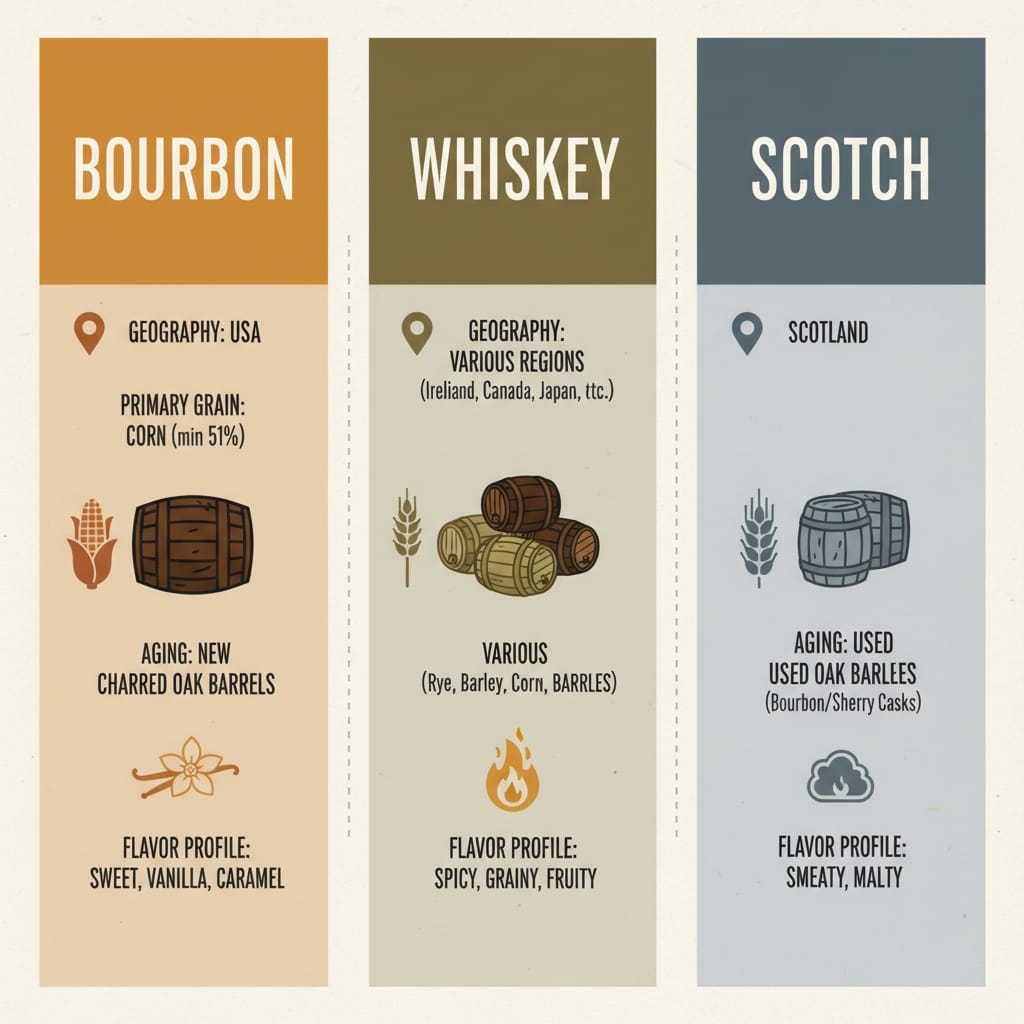
To truly understand the world of whiskey, you need to know the rules that define its major players. The core difference between bourbon and whiskey and its Scottish cousin, Scotch lies in a few non-negotiable legal requirements.
| Feature | Whiskey (General Category) | Bourbon Whiskey | Scotch Whisky |
|---|---|---|---|
| Geography | Can be made anywhere in the world. | Must be made in the United States. | Must be made in Scotland. |
| Primary Grain | Varies widely (barley, corn, rye, wheat). | Must be at least 51% corn. | Must be made from malted barley (for Single Malts). |
| Aging Barrel | Varies; can be new or used barrels. | Must be aged in new, charred oak barrels. | Must be aged in oak casks for at least 3 years (often used barrels). |
| Flavor Profile | Extremely diverse; can be spicy, smooth, smoky, or sweet. | Typically sweeter, with notes of vanilla, caramel, and oak. | Varies from light and floral to rich and smoky (from peat). |
| Additives | Rules vary by country. Some allow flavorings and coloring. | No coloring or flavoring may be added. Only water is allowed. | Only water and plain caramel coloring are permitted. |
What is Whiskey? The Global Spirit
Whiskey is the umbrella term for any distilled alcoholic beverage made from a fermented mash of grains. This can include barley, corn, rye, and wheat. After distillation, the spirit is almost always aged in wooden barrels, which gives it its color and a significant portion of its flavor. Ireland, Scotland, the United States, Canada, and Japan are the world’s most famous whiskey producers, and each has its own distinct style.
What is Bourbon? America’s Native Spirit
Bourbon is where the rules get specific. To earn the name bourbon whiskey, a spirit must adhere to strict U.S. federal laws. These regulations, often called the “Standards of Identity for Distilled Spirits,” are what give bourbon its consistent quality and signature flavor profile.
The non-negotiable rules for bourbon are:
- Made in the United States.
- The grain recipe (mash bill) must contain at least 51% corn.
- Aged in new, charred oak containers.
- Distilled to no more than 160 proof (80% ABV).
- Entered into the barrel for aging at no more than 125 proof (62.5% ABV).
- Bottled at 80 proof (40% ABV) or more.
- Contains no added flavors or coloring.
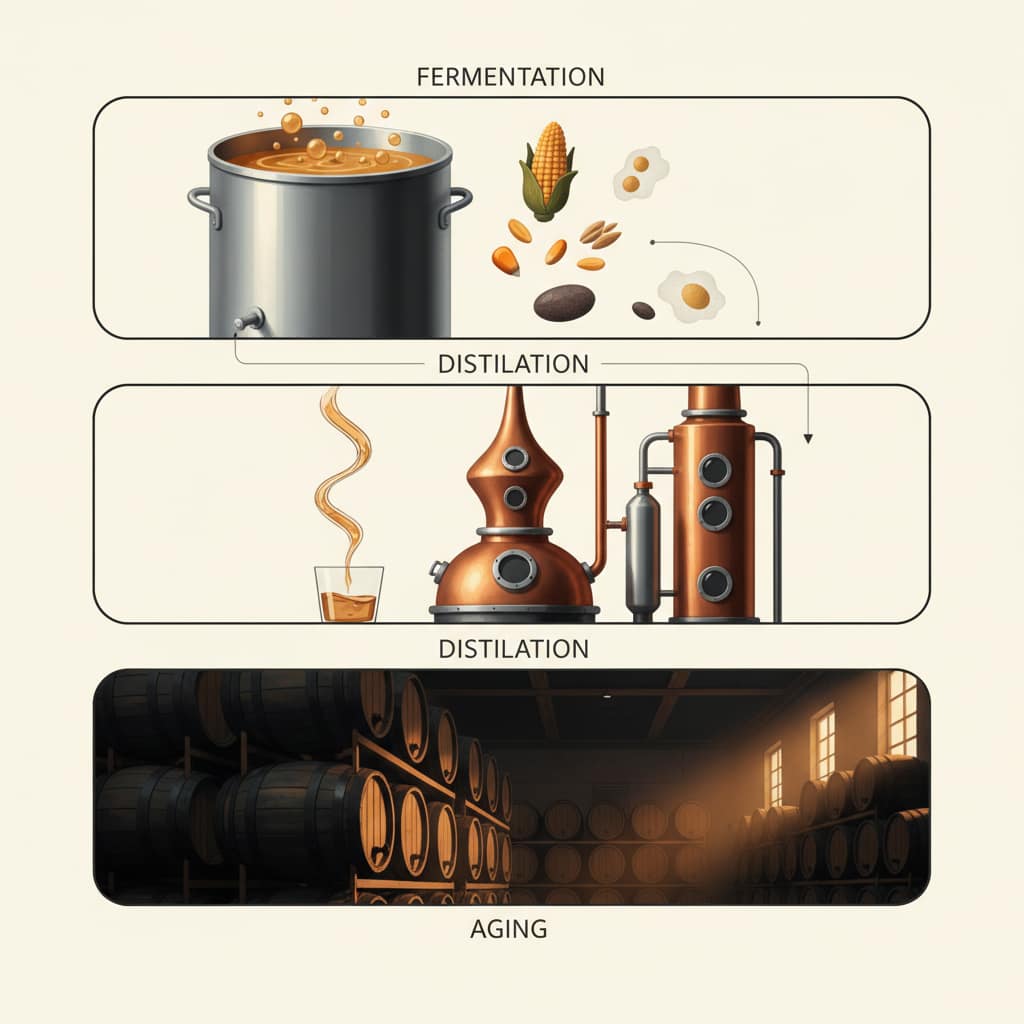
The high corn content makes bourbon noticeably sweeter than many other whiskeys, and aging in brand-new, charred oak barrels imparts its famous notes of vanilla, caramel, and toasty oak.
What about Scotch? The Spirit of Scotland
The main point of confusion after the bourbon vs whiskey question is often scotch whiskey vs bourbon. Scotch is whiskey made in Scotland, and like bourbon, it has its own strict set of laws. It must be made from malted barley (though other grains can be used in some blends) and aged in oak casks for a minimum of three years.
One of the most defining characteristics of many Scotches, particularly those from regions like Islay, is a smoky flavor. This comes from the process of drying the malted barley over fires fueled by peat—decomposed plant matter found in bogs across Scotland. This smokiness is a key differentiator from the sweeter profile of bourbon.
Cultural Significance and Modern Trends in 2026
Whiskey has always been more than a drink; it’s woven into the cultural fabric of the nations that produce it. Bourbon is synonymous with the American South, evoking images of Kentucky distilleries and Southern hospitality. Scotch is a symbol of Scottish heritage, a rugged and refined spirit shaped by its landscape.
In recent years, the global whiskey market has seen explosive growth, with a projected value of over $128 billion by 2026. This boom is driven by a few key trends:
- Premiumization: Consumers are drinking less but better, seeking out craft spirits with unique stories and flavor profiles.
- Global Palates: Japanese whisky and Irish whiskey are experiencing a massive resurgence, challenging the dominance of Scotch and Bourbon.
- Whiskey Tourism: Distillery tours are more popular than ever, with the Kentucky Bourbon Trail® welcoming over 2 million visitors annually.
Health, Pairings, and Enjoyment
When consumed in moderation, whiskey is not necessarily an unhealthy choice. As a distilled spirit, it is carbohydrate-free and gluten-free. Bourbon, in particular, contains antioxidants like ellagic acid from its time spent in charred oak barrels. Of course, moderation is key, as excessive alcohol consumption has well-documented health risks.
How you drink your whiskey is a matter of personal preference. Here are a few popular ways:
- Neat: Just the whiskey in a glass. This is the best way to appreciate the spirit’s pure, unadulterated flavor.
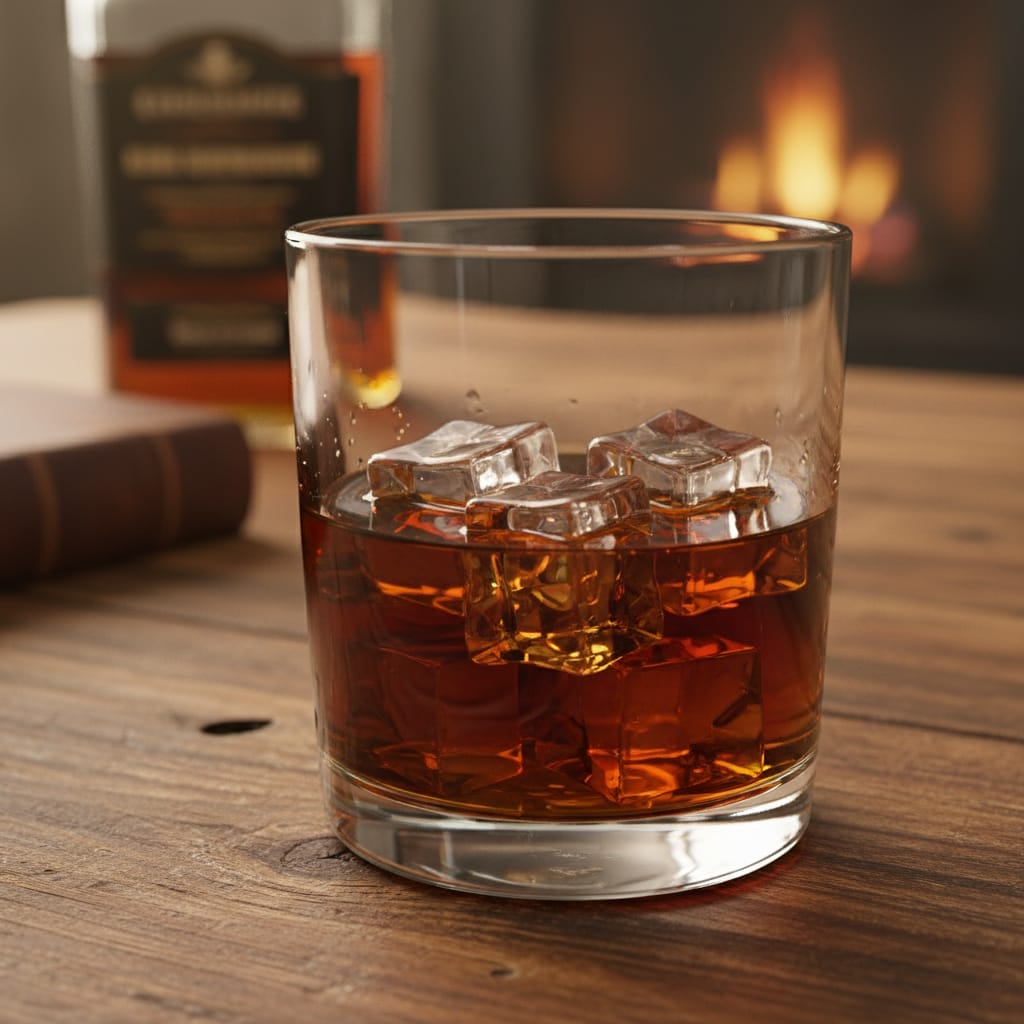
- On the Rocks: Served over ice, which slightly chills and dilutes the whiskey, opening up different flavors.
- With a Splash of Water: Adding a few drops of water can lower the alcohol concentration and release new aromatic compounds.
- In Cocktails: Bourbon is the star of classic cocktails like the Old Fashioned, Manhattan, and Whiskey Sour.
When it comes to food pairings, bourbon’s sweet and robust profile pairs beautifully with rich, savory foods like barbecue, grilled steak, and aged cheddar cheese. The smoky notes of a peated Scotch can stand up to smoked salmon or strong blue cheese.
Frequently Asked Questions (FAQs)
1. Is whiskey and bourbon the same?
No. All bourbon is a type of whiskey, but not all whiskey is bourbon. Whiskey is the broad category, while bourbon is a specific style of American whiskey with strict production rules.
2. What is the main difference between a bourbon and whiskey?
The three main differences are geography (bourbon must be made in the U.S.), ingredients (bourbon must be at least 51% corn), and aging (bourbon must be aged in new, charred oak barrels).
3. Is Jack Daniel’s a bourbon?
By law, Jack Daniel’s qualifies as a bourbon. However, the distillery prefers to market it as a “Tennessee Whiskey” because it undergoes an extra step the Lincoln County Process where the new spirit is filtered through sugar maple charcoal before aging.
4. Why is bourbon sweeter than other whiskeys?
Its sweetness comes from its primary ingredient: corn. A mash bill of at least 51% corn provides a high sugar content, which translates to sweeter notes in the final spirit.
5. What does “proof” mean?
Proof is a measure of alcohol content. In the United States, proof is double the alcohol by volume (ABV). For example, a whiskey that is 40% ABV is 80 proof.
6. Does whiskey expire?
Unopened, a bottle of whiskey will not expire. Once opened, it can slowly change flavor over time due to oxidation, but it will not spoil. It’s best to consume an opened bottle within a year or two for optimal taste.
7. Why is Scotch sometimes spelled “whisky”?
The spelling often denotes the country of origin. “Whisky” (without the “e”) is the traditional spelling for spirits from Scotland, Canada, and Japan. “Whiskey” (with the “e”) is typically used for spirits from the United States and Ireland.
8. Can bourbon be made outside of Kentucky?
Yes. While about 95% of the world’s bourbon is made in Kentucky, it can legally be produced anywhere in the United States as long as it follows the rules.
9. Is older whiskey always better?
Not necessarily. While age can add complexity and smoothness, the “best” whiskey is a matter of balance and personal taste. Some younger whiskeys are celebrated for their vibrant character.
10. What is a good beginner bourbon?
Look for “wheated” bourbons, like Maker’s Mark or W.L. Weller. These use wheat as the secondary grain instead of rye, resulting in a softer, smoother, and less spicy flavor profile that is often more approachable for new drinkers. For more recommendations, check out our guide to the best spirits for every palate.
The Final Pour
Understanding the bourbon vs whiskey distinction is your first step into a larger, more flavorful world. While bourbon is defined by its strict American heritage and corn-based sweetness, whiskey represents a globe-spanning tradition with endless variations. Each type, from the smoky depths of a Scotch to the spicy bite of a rye, tells a story of its origin.
The best way to learn is to taste. So go ahead, explore a new bottle, try a classic cocktail, and discover the rich history behind these timeless spirits.
To continue your journey, explore more expert guides and spirit reviews on www.flavorsuggest.com. Cheers!