
The Ultimate Guide to Georgian Red Wine (2026)
Imagine tasting a wine made using the exact same methods as one poured 8,000 years ago. When you uncork a bottle of red wine Georgia produces, you aren’t just opening a beverage; you are unlocking a time capsule.
While France and Italy often dominate the conversation, the small nation of Georgia in the Caucasus region is the true “Cradle of Wine.” Archaeologists have traced the world’s first winemaking back to Georgian soil around 6,000 BC (National Geographic). Today, this ancient tradition is experiencing a massive renaissance. From the deep, inky depths of Saperavi to the semi sweet velvet of Kindzmarauli, Georgian red wine is captivating palates globally.
If you are tired of the usual Merlots and Cabernets and want to explore something bold, historic, and utterly unique, this guide is for you. We will dive deep into the varieties, the ancient Qvevri method, and exactly how to choose the best bottle for your dinner table.
Why Red Wine from Georgia is Unlike Anything Else
To understand why red wine Georgia exports is so special, you have to look beyond the grape. It is about the philosophy. In the West, wine is often “made.” In Georgia, the saying goes that wine is “born.”
The 8,000-Year Heritage
Georgia isn’t new to this. While the rest of the world was figuring out agriculture, Georgians were already fermenting grapes. This 8,000-year unbroken tradition has survived invasions and empires, preserving over 500 indigenous grape varieties more than almost any other country in the world (University of California, Davis).
The Magic of the Qvevri
The most distinct feature of traditional Georgian red is the vessel it’s born in: the Qvevri. These are massive, lemon-shaped clay vessels buried underground. Unlike stainless steel tanks or oak barrels, Qvevri provide a stable temperature and allow for a natural micro-oxygenation that oak barrels mimic but never quite duplicate.
In 2013, UNESCO recognized the traditional Georgian Qvevri wine-making method as an Intangible Cultural Heritage of Humanity. When you drink a Qvevri Georgian red wine, you are tasting history.
A Unique Terroir
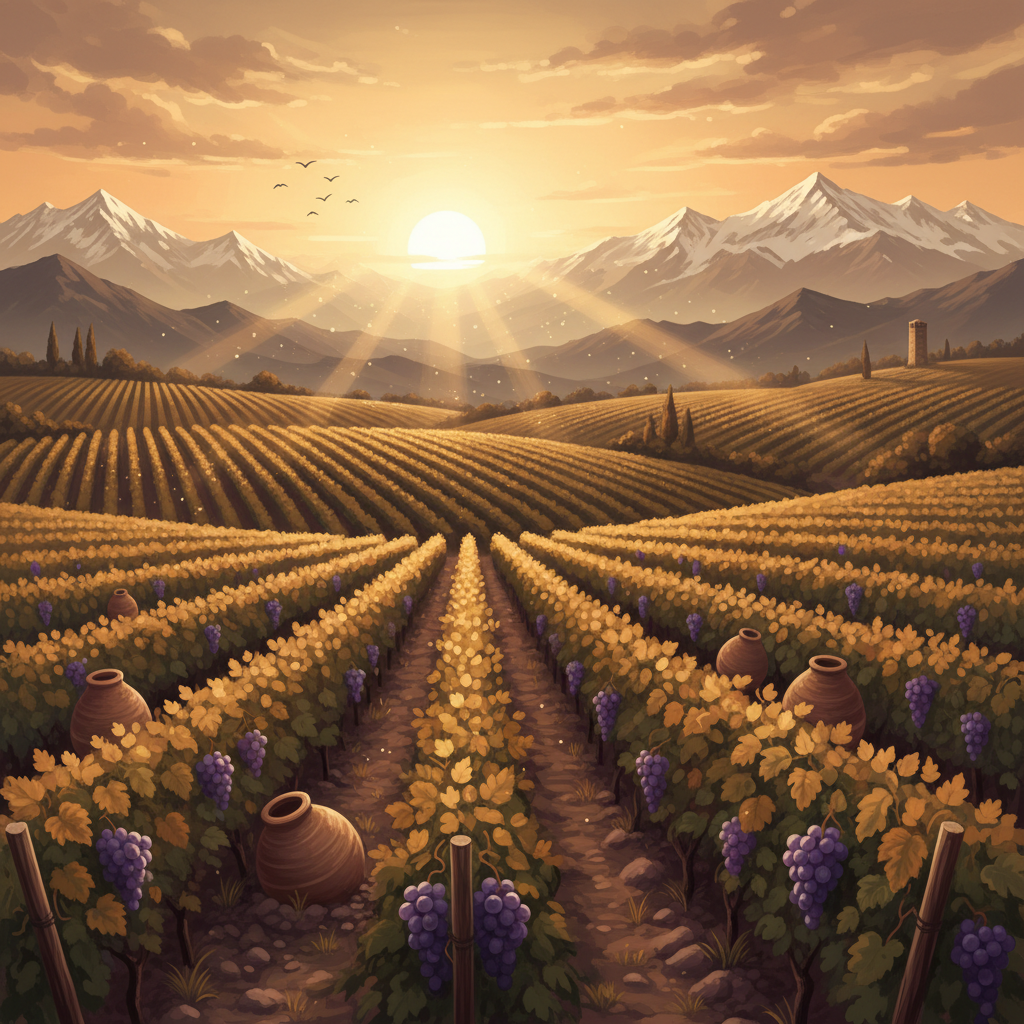
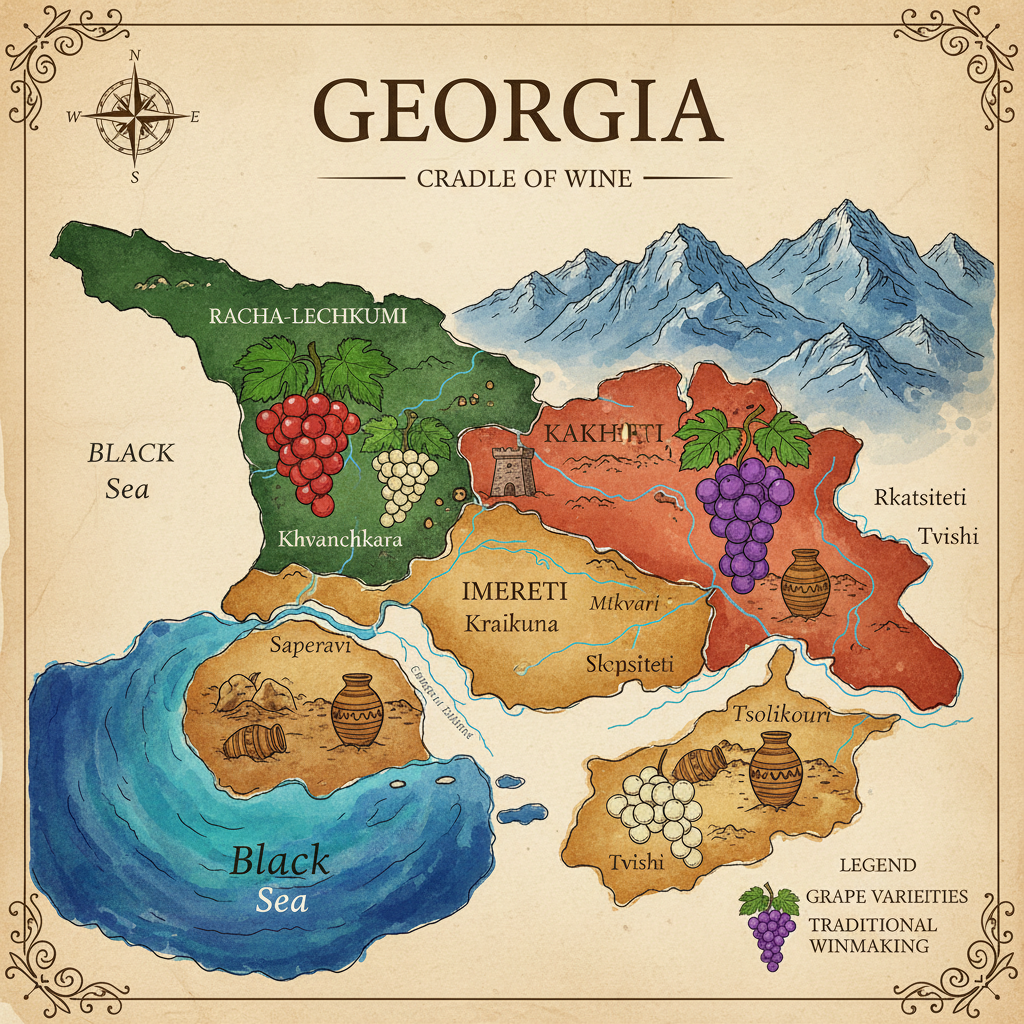
Located at the intersection of Europe and Asia, Georgia’s diverse climate ranges from subtropical marshes to eternal snow peaks. The Caucasus Mountains protect the vineyards from cold northern air, while the Black Sea influences the humidity. This creates perfect conditions for bold, high-tannin reds that can age for decades.
The Kings of Georgian Red: Top Varieties You Must Try
If you walk into a shop looking for Georgian red wine, you might be overwhelmed by unfamiliar names. Forget Cabernet and Pinot Noir for a moment. Here are the indigenous heroes you need to know.
Saperavi: The Giant of Georgia
If Georgian wine has a king, it is Saperavi. The name literally translates to “dye” or “paint,” which is fitting because this is one of the few teinturier grapes in the world meaning the flesh inside the grape is red, not just the skin (Wine Enthusiast).
- Flavor Profile: Think dark berries, licorice, grilled meat, tobacco, and spices. It is full-bodied, high in acidity, and high in tannins.
- Aging Potential: Excellent. Saperavi can age gracefully for decades.
- Best For: Lovers of Malbec or Cabernet Sauvignon.
Aleksandrouli: The Smooth Operator
Grown primarily in the Racha region, Aleksandrouli is softer and more elegant than the powerhouse Saperavi. It is often the backbone of the famous Khvanchkara blend.
- Flavor Profile: Raspberries, black cherries, and a hint of pomegranate.
- Best For: Those who enjoy Pinot Noir or Grenache.
Mujuretuli: The Perfect Partner
Rarely found as a single varietal, Mujuretuli is almost always blended with Aleksandrouli to add structure and depth to semi-sweet wines.
Shavkapito: The Royal Comeback
Once a favorite of Georgian royalty, this variety was nearly extinct but has made a massive comeback. It produces lighter, more aromatic reds.
- Flavor Profile: Smoky, leathery notes with bright red fruit.
- Best For: Adventurous drinkers looking for complexity over power.
Ojaleshi: The Western Gem
Grown in the Samegrelo region, Ojaleshi was traditionally trained to grow up trees rather than on trellises. It produces rich, semi-sweet wines with intense rose and berry aromas.
Famous Appellations (PDOs) Explained
In Georgia, the name on the bottle often refers to the specific micro-zone (Protected Designation of Origin, or PDO) rather than just the grape. Here is how to decode the label.
1. Mukuzani (Dry)
- Grape: 100% Saperavi.
- Style: Dry, oak-aged.
- Character: This is often considered the most complex dry Georgian red wine. It is aged in oak (not Qvevri) for at least three years, smoothing out Saperavi’s intense tannins. Expect notes of vanilla, chocolate, and black cherry.
2. Kindzmarauli (Semi-Sweet)
- Grape: 100% Saperavi.
- Style: Naturally semi-sweet.
- Character: Harvested late in the season when sugar content is high, fermentation is stopped naturally by winter cooling. It tastes like jammy blackberries and plums but retains enough acidity to avoid being cloying.
3. Khvanchkara (Semi-Sweet)
- Grapes: Aleksandrouli and Mujuretuli.
- Style: Naturally semi-sweet.
- Character: Historically famous (and rumored to be Stalin’s favorite wine), this comes from the Racha region. It has a distinctive raspberry nose and a velvety texture.
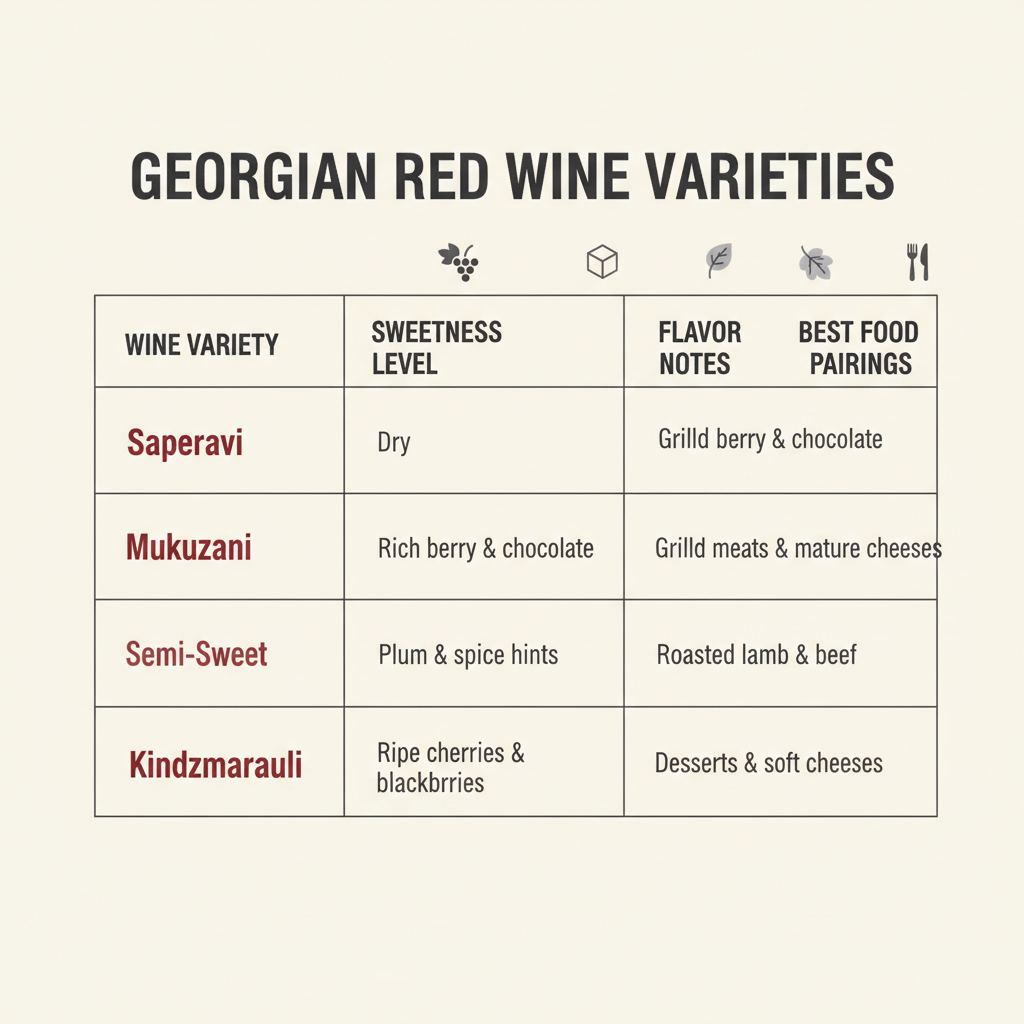
Quick Comparison: Top Georgian Red Wines
| Name on Bottle | Primary Grape | Sweetness Level | Key Flavor Notes | Best Paired With |
|---|---|---|---|---|
| Mukuzani | Saperavi | Dry | Oak, black cherry, dark chocolate | Grilled steak, lamb chops |
| Saperavi | Saperavi | Dry | Blackberry, spice, earth | Burgers, stews, hard cheese |
| Kindzmarauli | Saperavi | Semi-Sweet | Jammy fruit, violet, plum | Spicy Asian food, fruit tart |
| Khvanchkara | Aleksandrouli | Semi-Sweet | Raspberry, strawberry, almond | Soft cheese, walnuts, desserts |
| Akhasheni | Saperavi | Semi-Sweet | Cherries, chocolate | Chocolate desserts, blue cheese |
The Ancient Qvevri Method: A Winemaking Revolution
You cannot discuss red wine Georgia produces without understanding the Qvevri. While European wine separates the juice from the skins early, traditional Georgian Qvevri wine leaves them together for months.
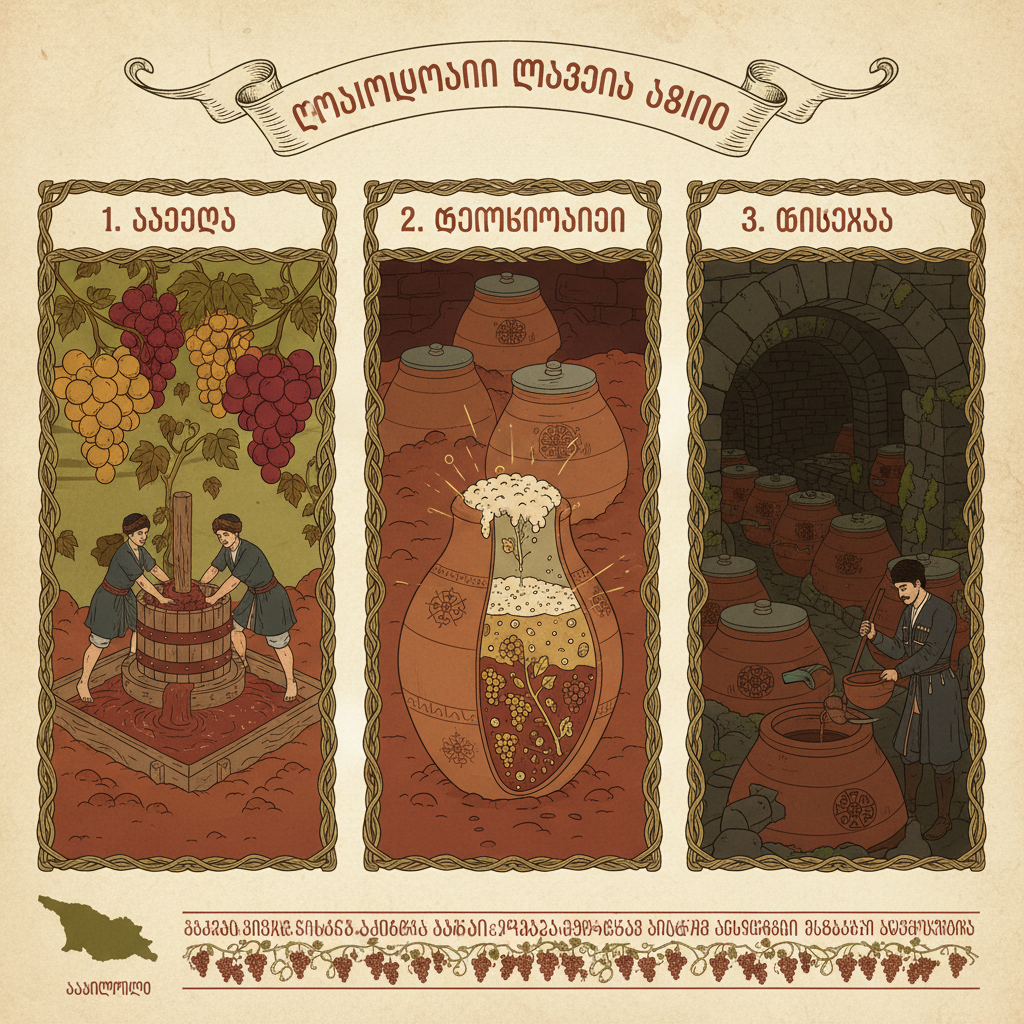
How It Works (Visual Guide Description)
- Step 1: Pressing. Grapes are crushed in a hollowed-out tree trunk (Satsnakheli).
- Step 2: Filling. The juice, skins, stalks, and seeds (collectively called “chacha”) are poured into the clay Qvevri buried in the ground.
- Step 3: Fermentation. Natural yeasts start fermentation. The earth keeps the temperature stable naturally.
- Step 4: Sealing. Once fermentation stops, the Qvevri is sealed with clay or a stone lid and left for up to 6 months.
- Step 5: Clarification. The solid matter sinks to the pointed bottom of the vessel, leaving crystal-clear, distinctively textured wine on top.
This method gives Georgian red massive structure and tannins, making them incredibly healthy (packed with antioxidants) and stable without added sulfites (Smithsonian Magazine).
How to Choose the Best Georgian Red Wine
Walking down the wine aisle or browsing online? Here is how to ensure you pick a winner.
1. Check the Production Method
Not all Georgian wine is made in Qvevri.
- European Style: Fermented in stainless steel or oak. Cleaner, fruit-forward, more familiar to Western palates. (Look for brands like Teliani Valley or Château Mukhrani).
- Traditional/Qvevri: Fermented in clay. Earthy, tannic, complex. The label will usually proudly state “Qvevri” or “Kvevri.”
2. Know Your Sweetness Preference
This is the biggest tripping point for beginners. Georgia is famous for high quality semi-sweet reds, which is rare elsewhere.
- If you like Dry: Look for Mukuzani, Napareuli, or simply Saperavi.
- If you like Sweet: Look for Kindzmarauli, Khvanchkara, or Akhasheni.
3. Inspect the Vintage
While Saperavi ages beautifully, fresher styles (2–4 years old) are often best for fruit-forward drinking. For Qvevri wines, don’t be afraid of older vintages (5–10 years); the tannins soften beautifully over time.
4. Authenticity Markers
Look for the holographic seal on the Georgian wine bottle. The National Wine Agency of Georgia strictly controls PDO wines to prevent counterfeits (Georgia National Wine Agency).
Where to Get Georgian Vine and Wine Brands
Finding these gems used to be a challenge, but distribution has improved drastically.
Top Georgia Wine Brands to Look For
- Teliani Valley: Accessible, consistent quality, great entry-level wines.
- Badagoni: One of the largest producers, widely available.
- Orgo / Dakishvili: High-end, artisanal Qvevri wines. Excellent for connoisseurs.
- Château Mukhrani: A royal estate producing premium European-style wines.
- Pheasant’s Tears: The cult favorite for natural, organic Qvevri wine lovers.
Buying Online vs. Local
If you are wondering where to get Georgian vine products or specific wine bottles, specialized online retailers are your best bet. While Total Wine and local boutique shops carry basics like Saperavi, online stores specializing in “Eastern European” or “Natural Wines” will have the deep cuts like Shavkapito.
Perfect Pairings: Food and Georgian Red
Georgian culture revolves around the Supra a feast led by a toastmaster (Tamada). Their wines are built for food.
Traditional Pairings
- Grilled Meats (Mtsvadi): The smoke of pork or lamb skewers cuts through the tannins of a dry Saperavi perfectly.
- Khinkali (Dumplings): The spiced meat filling of these soup dumplings pairs well with a robust Mukuzani.
- Walnut Sauces: Georgian cuisine uses heavy walnut pastes. The tannins in Qvevri wines bind with the proteins in walnuts, creating a creamy mouthfeel.
Modern Western Pairings
- BBQ Ribs: The slight sweetness of a Kindzmarauli works magic with sticky BBQ sauce.
- Blue Cheese: Try a semi-sweet Khvanchkara with a pungent Roquefort. The sweetness balances the saltiness perfectly.
- Pizza: A young, stainless-steel fermented Saperavi is the ultimate pizza wine better than Chianti.
Frequently Asked Questions (FAQs)
1. What is the most popular red wine in Georgia?
Saperavi is the most widely grown and consumed red grape (Wine Enthusiast). However, in terms of specific appellations, Kindzmarauli (semi-sweet) is incredibly popular globally for its approachable taste.
2. Is Georgian red wine sweet or dry?
It is both! Georgia is unique because it produces high-quality wines in both styles. Mukuzani is a world-class dry red, while Khvanchkara is a premium semi-sweet. Always check the label.
3. Why is Georgian wine so dark?
The Saperavi grape is a teinturier variety, meaning it has red flesh and red juice (most red grapes have clear juice). This results in an inky, deep purple color that can stain your teeth a badge of honor!
4. How do you serve Georgian red wine?
Treat dry reds like Saperavi as you would a Cabernet serve at roughly 60-65°F (16-18°C). Semi-sweet reds like Kindzmarauli should be served slightly chilled, around 55°F (12°C), to keep the sweetness fresh, not syrupy.
5. What does “Qvevri” taste like?
Red wines made in Qvevri are more textured and “grippy” than standard reds. You might taste savory notes like dried herbs, leather, and earth alongside the fruit. They are often described as “energetic” or “living” wines.
6. Is Georgian wine organic?
Many small producers practice organic or biodynamic farming by default, even if uncertified. The traditional Qvevri method is inherently low-intervention “natural” winemaking.
7. How long can I keep a bottle of Georgian wine?
Dry Saperavi wines, especially those aged in oak (Mukuzani), can age for 10–20 years. Semi-sweet wines are generally best consumed within 2–4 years of bottling to preserve their fresh fruit character.
8. What foods pair best with semi-sweet Georgian red wine?
Avoid pairing them with main courses unless the dish is spicy (like spicy Asian noodles). They shine best with desserts, fruit tarts, soft cheeses, or simply as a standalone drink after dinner.
9. Why have I never heard of Georgian wine before?
During the Soviet era, Georgian wine was mass-produced for the Russian market, emphasizing quantity over quality. Since the 2000s, Georgia has pivoted back to its ancient roots, focusing on premium quality and exporting to the West.
10. Where is the main wine region in Georgia?
Kakheti, in the east, produces about 70% of all Georgian wine. It is the heartland of the Saperavi grape and the Qvevri tradition (OIV – International Organisation of Vine and Wine).
Conclusion: Your Next Bottle Awaits
The world of red wine Georgia offers is vast, ancient, and incredibly exciting. It is a journey that takes you from the snowy peaks of the Caucasus to the clay vessels buried deep within the earth. Whether you pour a glass of inky, dry Saperavi or indulge in the berry rich sweetness of Kindzmarauli, you are participating in a tradition that has outlived empires.
These wines are not just a beverage; they are a testament to resilience and culture. They demand to be shared, toasted with, and enjoyed with good food and great company.
Ready to find your perfect Georgian pour? Visit www.flavorsuggest.com for curated recommendations and to discover more about the world’s most unique flavors.